Optimisation Is Not a Tidy-Up
Campaign optimisation is often treated like a quick clean-up when results dip. In reality, it works best as a steady rhythm of learning, testing and improvement.
Campaign optimisation is often treated like a quick clean-up when results dip. In reality, it works best as a steady rhythm of learning, testing and improvement.
A campaign tidy-up can feel productive.
There is usually a list. There is often a spreadsheet. There may be a new report, a revised headline, a paused advert, a rewritten landing page or a sudden burst of AI-generated content ideas. Everyone can see activity happening, which makes it feel like progress.
Sometimes, that activity does help. A poor headline may need changing. A weak landing page may need tightening. An advert may have run its course. A report may reveal something useful.
But in many cases, the tidy-up is only marketing housework. It deals with the visible mess, not the underlying pattern.
That is the difference between reacting to a problem and building a proper optimisation rhythm.
The problem with rescue-mode marketing
Most teams recognise the moment when performance starts to wobble. Leads slow down. Enquiries become less relevant. Cost per result moves in the wrong direction. Website traffic arrives but does not convert. Social visibility becomes inconsistent. The campaign that felt promising now feels uncomfortable.
At that point, the instinct is often to fix whatever is most visible.
Change the headline. Pause the advert. Rewrite the landing page. Add more reporting. Ask AI for ten new angles and hope one of them feels sharp enough to solve the issue.
None of these actions are automatically wrong. The problem is that they are often disconnected. They are treated as emergency repairs rather than part of a structured learning process.
When optimisation becomes a rescue job, it usually focuses on symptoms. The numbers are down, so something must be changed quickly. The team gets busy, but the campaign does not necessarily get clearer. A few surface-level edits may buy time, yet the same problems often return in a slightly different form.
This is why optimisation should not be viewed as a one-off clean-up. It needs to be a rhythm.
Optimisation is a rhythm, not a reaction
A useful optimisation process does not start with panic. It starts with a better question.
Instead of asking, "What needs fixing?", ask, "What is the next most valuable thing to learn?"
That shift matters. It turns optimisation from a reactive scramble into a roadmap. It encourages you to look at the whole system: the audience, the message, the channel, the conversion point, the follow-up and the quality of the conversations being created.
A campaign is rarely just one asset. It is a chain of moments. Someone sees a post, an advert or a search result. They decide whether it feels relevant. They click, read, watch or ignore. They land on a page, scan the content and decide whether to take a next step. They may enquire, book, download, subscribe or leave. If they do make contact, the quality of that conversation matters too.
Optimisation works when you inspect that chain carefully and improve the right link at the right time.
Look beyond clicks
Clicks are easy to measure, which makes them tempting to overvalue. A campaign can generate attention without generating meaningful progress. A post can attract engagement without building trust. An advert can drive visitors who are unlikely to become good-fit enquiries.
That does not mean clicks are irrelevant. They are a useful signal. But they are only one part of the picture.
Good optimisation looks at what happens after the click. Are the right people arriving? Do they understand the offer? Does the page answer the questions they are likely to have? Is the next step clear? Are enquiries becoming useful conversations? Are those conversations aligned with the type of work the business actually wants?
This is especially important for businesses where quality matters more than volume. More traffic is not automatically better. More leads are not automatically better. If a campaign is attracting the wrong people, the issue may not be the landing page or the form. It may be the message, the targeting or the channel itself.
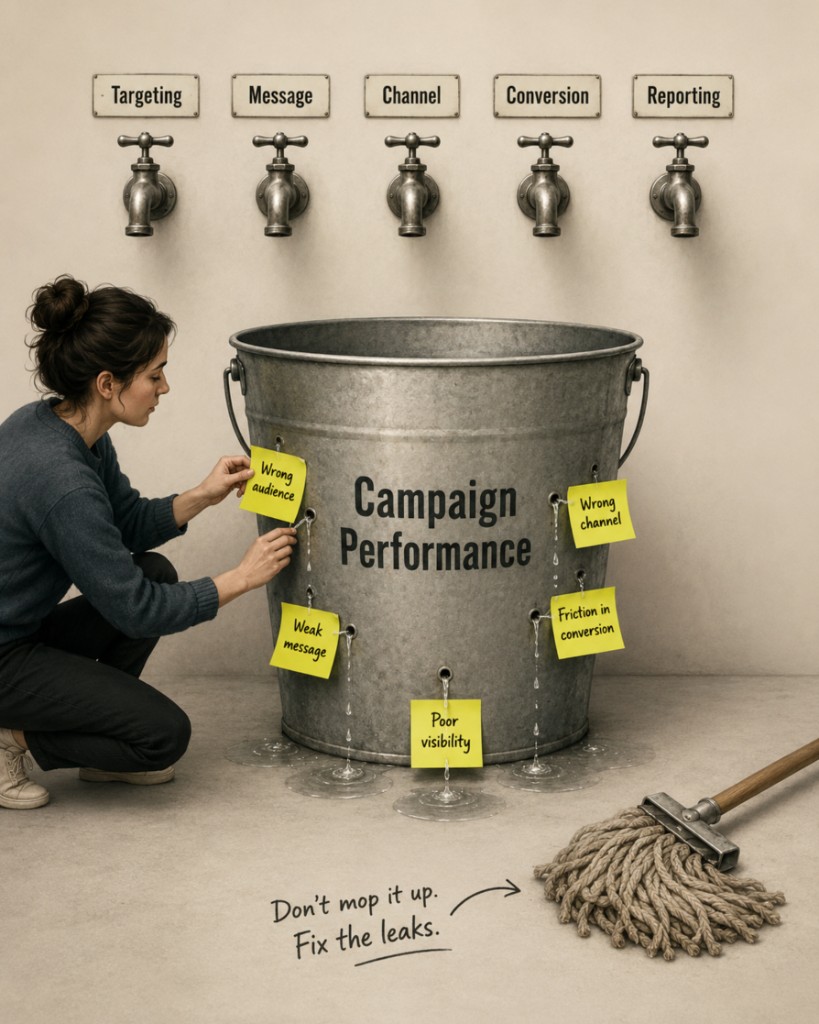
The five places campaigns often leak
When campaign performance feels inconsistent, it can help to look for the biggest leak. The answer is not always obvious, but most issues tend to sit in one of five areas.
1. Targeting
Targeting is about whether the campaign is reaching the right people in the first place. If the audience is too broad, too vague or based on assumptions, the rest of the campaign has to work much harder.
Strong targeting does not only mean demographic precision. It also means understanding context. What problem is the audience aware of? What are they trying to improve? What would make them take action now rather than later? What do they already believe, and what might they be unsure about?
If the wrong people are seeing the message, even a polished campaign can underperform.
2. Message
The message is often where teams make the quickest changes. Headlines are rewritten, copy is adjusted and new angles are tested. This can be valuable, but only if the changes are based on a clear hypothesis.
A useful message should make the audience feel recognised. It should connect the problem, the desired outcome and the reason to take the next step. It should be specific enough to be credible and simple enough to be understood quickly.
If people are seeing the campaign but not responding, the message may not be landing. It may be too generic, too clever, too internally focused or too disconnected from what the audience actually cares about.
3. Channel
Different channels create different expectations. What works in search may not work on LinkedIn. What works in email may not work in paid social. What works for warm audiences may fail with cold ones.
A channel is not just a distribution tool. It shapes how people encounter your message. Someone actively searching for a solution is in a different mindset from someone scrolling through a social feed. A founder reading a thoughtful LinkedIn post may need a different next step from a visitor comparing service pages on a website.
If the channel is wrong for the objective, optimisation becomes difficult. You may be improving the assets without addressing the mismatch.
4. Conversion point
The conversion point is where interest becomes action. This could be a contact form, a booking link, a download, a product page, a call-to-action section or a sales conversation.
This is where many campaigns lose momentum. The audience may be interested, but the next step may feel unclear, too demanding or poorly timed. The page may not build enough confidence. The form may ask for too much. The offer may not match the level of trust that has been created.
Improving the conversion point does not always mean making it shorter or simpler. It means making it appropriate. The more complex or considered the decision, the more reassurance and clarity people may need before they act.
5. Reporting
Reporting should help decisions, not simply document activity. A report that contains a lot of numbers but does not clarify what to do next can create the illusion of control.
Good reporting connects performance to questions. What are we trying to learn? Which part of the campaign are we testing? What changed? What stayed the same? What does the data suggest we should improve next?
This is where AI and software can support the process, especially when teams need to organise information, spot patterns or move faster. But tools do not replace judgement. Data still needs context. Automation still needs direction. Dashboards still need interpretation.
LinkedIn visibility follows the same rule
The same principle applies to LinkedIn visibility. A founder or senior team member posting once in a panic rarely builds trust. It may create a short burst of activity, but it does not create a reliable presence.
Trust is built through consistency. A clear voice, repeated with intent, gives people a better understanding of how you think, what you value and where you can help. That does not mean posting for the sake of it. It means treating visibility as part of the wider optimisation rhythm.
What topics create useful conversations? Which posts attract the right kind of attention? Which ideas are worth expanding into articles, videos, email content or campaign themes? Where is the audience showing curiosity, confusion or resistance?
LinkedIn can be more than a broadcasting channel. Used well, it becomes a learning channel.
From tidy-up to roadmap
A tidy-up is not useless. Campaigns do need maintenance. Assets become tired. Pages need improving. Reports need cleaning. Messages need refining.
The risk is mistaking maintenance for optimisation.
Optimisation compounds when it is consistent. Test the message. Watch the channel. Check the conversion point. Review the quality of conversations, not just the clicks. Use the data to decide what gets improved next. Then repeat the process.
That rhythm is less dramatic than a big relaunch. It is also more useful. It helps teams avoid random changes, learn faster and make better decisions over time.
For a business like GoNow Productions, where AI, software development, digital marketing and optimisation often overlap, this mindset is especially important. A website, application, prototype or campaign should not be seen as static once it goes live. The launch is only one stage. The real value often comes from what is learned after people start using it.
The most useful question is not always, "What needs fixing?"
It is, "What is the next most valuable thing to learn?"
That question changes the work. It shifts the focus from panic to progress, from cosmetic edits to meaningful improvement, and from one-off tidy-ups to a practical roadmap for growth.
About the Author
Jason Leven is CEO and Co-Founder of GoNow Productions, a GEO and AI digital agency based in Barcelona. He has 25+ years of experience in software development, digital search, and SEO across 21 countries. LinkedIn →
GoNow Productions produces this content and offers commercial services in AI search optimisation for retail.
Related Articles
Build the Prototype Before You Build the Team
Hiring a development team too early can turn an untested idea into an expensive commitment. A working prototype helps founders learn what matters before they scale.
Active Play Is Becoming the New Retail Anchor
Why active play is becoming a new retail anchor, helping centres turn footfall into movement, discovery and longer visits.